Skip to main content
Skip to footer
Skip to main content
Skip to footer


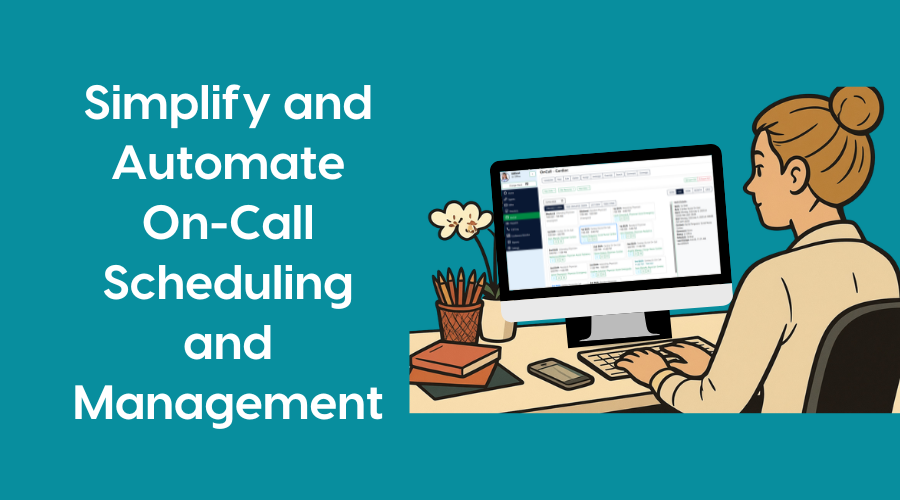
In the high-stakes environment of today’s hospital call centers and healthcare facilities, fragmented information and data remain persistent threats to operational safety and efficiency. Legacy environments often force agents to juggle multiple disconnected programs just to identify who is on call and how to reach them.
We are now able to use just Amtelco’s on-call scheduling app to integrate and update the third-party vendor schedules. No one has to manage two or three different schedules or manually input shifts into different scheduling platforms. The app is easy for operators and hospital staff to use. Monica Belo, Sr. Systems Analyst, Revenue Cycle Applications for NorthBay Health, in Solano County, California (Customer quote from an Amtelco case study with NorthBay Health: Addressing Pain Points with Upgraded Call Center Software)
Reliance on paper calendars and siloed spreadsheets creates a “shadow calendar” where any manual updates made after a schedule is printed becomes hidden. The result is a dangerous communication vacuum: critical notifications are sent to off-duty staff, response times lag, and the risk of medical error increases.
- Communication Silos: Agents waste time looking up on-call schedules and whether a doctor prefers a phone call or secure text.
- On-Call Ambiguity: Real-world “who is on call?” questions often lead to wrong-number pages.
- Communication Lag: If a doctor swaps a shift and the call center or emergency department (ED) isn’t notified in real time, the consequences can be catastrophic.

A unified, widget-based on-call scheduling app consolidates fragmented functions into a single, responsive interface, eliminating the need for agents to jump between disconnected systems to find data. By serving as a single source of truth (SSOT), the app ensures that the surgeon at home, the desktop agent working remotely, and the supervisor walking the floor at the hospital call center have access to the same real-time data.
We used to spend two or three days at the end of the month getting on-call schedules ready for the next month. With Amtelco’s app, the work is done in two to three hours, and the schedules are pushed to the departments so they can manage their own schedules. Monica Belo, Sr. Systems Analyst, Revenue Cycle Applications for NorthBay Health, in Solano County, California
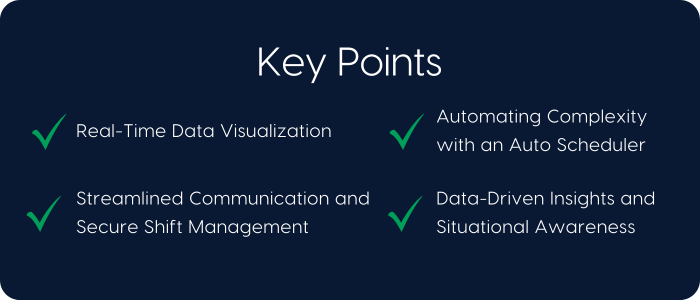
Real-Time Data Visualization
On-call information can be displayed in multiple views that enable users to view shifts for the current time, day, week, or month. Each view includes settings to customize how data is displayed. Users can choose to display shifts on cards or in lists and determine which shifts are displayed in the view.
Automating Complexity with an Auto Scheduler
One of the most significant logistical nightmares in healthcare is the manual management of complex rotations. Auto-scheduling features transform this process from a days-long administrative task into an automated rules engine. By configuring custom rules for credentialing, skill sets, and rest requirements, the system ensures that assignments are safe, fair, and compliant. With transparent, data-driven scheduling, staff can trust that holiday and weekend rotations are distributed equitably.
On-call scheduling is rarely a simple rotation. It involves complex constraints that an auto-scheduler handles automatically:
- Credentialing and Skill Sets: Using rules, the system can ensure that the person assigned to a shift actually has the required certifications (e.g., a Level 1 Trauma surgeon is always on the roster).
- Rest Requirements: Resting time can be baked into the software design to prevent a doctor from being scheduled for a morning shift immediately after a 24-hour on-call stint.
- Equity Logic: The software can balance unpopular shifts across the entire team based on historical data.
Amtelco’s app has definitely cut the time it takes to enter on-call schedules in half. I can make recurring schedules for staff and even add comments. It has been absolutely wonderful. Falisa Fullard, Trauma Department Executive Assistant for Washington Health in Fremont, California (Customer quote from an Amtelco case study with Washington Health: Updating the Emergency Department Scheduling from a Paper Process to a Digital Platform)
Streamlined Communication and Secure Shift Management Beyond scheduling, on-call scheduling apps solve the communication silo problem by integrating a comprehensive Directory and Inbox directly into the workflow. Agents no longer have to guess a provider’s preference; they can send messages via a secure messaging app, SMS, email, pager, or fax from a single screen. This is bolstered by Status settings, which allow individual users to control their own contact preferences, automatically updating the enterprise directory in real time so that urgent messages always reach the right person on the first try.
One thing we love about the on-call directory is that we can click on a button that highlights only the available staff who are actually on-call at that very moment. It prevents a lot of confusion, especially when an override has been done for last-minute schedule changes. Ashley Banuelos, PBX Supervisor for Ephraim McDowell Health in Danville, Kentucky (Customer quote from an Amtelco case study with Ephraim McDowell Health: Leveraging Directories to Improve Call Flows and Reduce Code Call Errors)
Crucially, on-call scheduling apps address the inherent risks of shift swapping. In manual systems, a swap hasn’t been communicated until a master list is updated. Within an app, shift management becomes an enterprise-wide update. When a staff member requests a digital swap, the system acts as a safety gate, blocking trades that violate any rules imposed by the system and instantly syncing across the hospital, providing a clear audit trail for compliance and ensuring that the wrong person isn’t contacted during a crisis.
Data-Driven Insights and Situational Awareness Finally, on-call scheduling apps shift reporting from retrospective to active management. Users can keep track of on-call communications to maintain complete and accurate statistics and maintain accountability.
We generate a monthly report that contains all of the on-call schedule assignments for the current and previous month that is used to ensure physicians are paid accurately and on time. There are a lot of very helpful reports I can generate from Amtelco’s platform. Jessica Javier, Inpatient Orders Application Analyst for Washington Health in Fremont, California
It is surprisingly common for hospitals to rely on manual processes for on-call scheduling. By transitioning from manual, paper-based workflows to an on-call scheduling app using a real-time digital environment, organizations do more than just improve efficiency—they create a safer, more resilient ecosystem for both their staff and the patients they serve.
Amtelco’s on-call scheduling app is user-friendly. To sit down and look at it, and then figure out how to do something with a program you’re not familiar with within a few minutes—if that isn’t user-friendly, I don’t know what is. Brenda Frieboes, On-Call Manager for Providence Swedish (Customer quote from an Amtelco case study with Providence Swedish: Improving On-Call Communication Delays and Code Call Workflows with Web-Based Platforms)