Skip to main content
Skip to footer
Skip to main content
Skip to footer


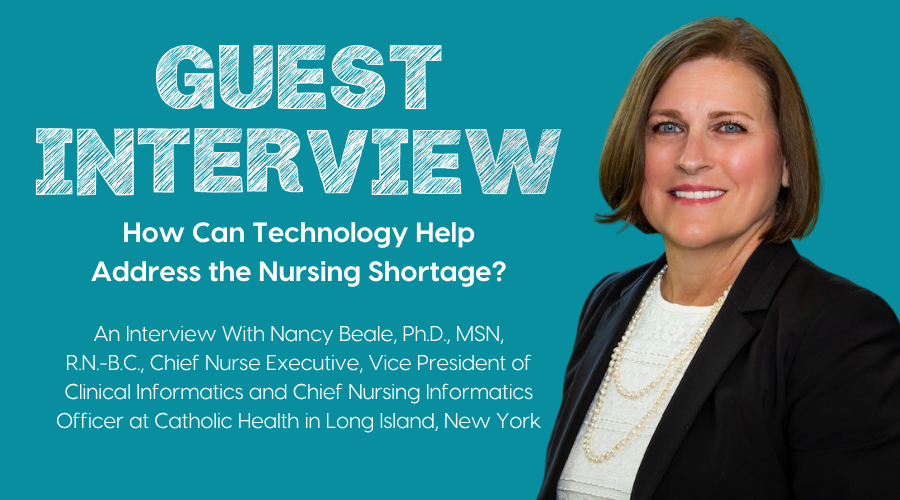
Nancy Beale, Ph.D., MSN, R.N.-B.C., Chief Nurse Executive, is an executive healthcare information technology (IT) leader, 2019 recipient of the HIMSS-ANI Nursing Informatics Leadership Award, co-chair for the Alliance for Nursing Informatics, a participant in the NBRC, advisory board member for Autonomous Pharmacy and Health Tequity, member of the IHE USA Board of Directors, and past President of Telemetrix.
In addition, Nancy leads the clinical systems teams, standardizing practices, reducing administrative burdens, and overseeing technology, including the digital-first implementations at the Good Samaritan Pavilion, and frequently speaks on how to successfully implement AI and virtual care tools that save nurses time rather than adding administrative frustration.
Nancy currently serves as the Vice President of Clinical Informatics and Chief Nursing Informatics Officer at Catholic Health in Long Island, New York. Her work is heavily focused on transforming patient care and bridging the gap between clinical expertise and digital health innovation.
Amtelco has been fortunate to consult with Nancy for many years. As the wife of our VP of Customer Operations, Greg Beale, Nancy has provided invaluable insight into the pain points nurses experience. We spoke with Nancy about her thoughts on nursing and technology.
The nursing shortage in the United States has ebbed and flowed for decades, but the pandemic exacerbated the nursing deficit. A 2021 McKinsey survey found that 22% of direct-care nurses were considering leaving their positions within a year due to inadequate staffing levels, extreme workloads, and the job’s physical demands.
Compounding this challenge is that prospective nursing students are being waitlisted due to a lack of instructors. Data released by the American Association of Colleges of Nursing (AACN) showed that 80,521 qualified applicants were turned away from nursing schools in 2020, primarily due to shortages of clinical sites, teaching staff, and resource constraints. But an additional 200,000 nurses will be needed by 2029, the AACN projects. Some institutions are turning to a lottery system to reduce the number of accepted applicants.
These tough issues are further complicated by the following factors: the demand for patient care is rising, our educational system can’t keep up with surging enrollment, and hospital systems are also facing their worst financial crisis in recent years. The solutions to the nursing shortage are complicated, but they aren’t impossible. The Journal of Nursing Administration has published multiple articles on ways to address and stabilize the nursing crisis.
The American Medical Informatics Association (AMIA) recently hosted the National Burden Reduction Collaborative (NBRC), sponsored by Epic, during the AMIA 2022 Annual Symposium. It’s a collaboration with the Association of Medical Directors of Information Systems and the Alliance for Nursing Informatics.
“The NBRC spent two days sharing their ongoing research, knowledge, and initiatives around documentation burden and clinician burnout reduction to understand organizational priorities and align efforts,” an AMIA press release stated.
The use of technology is being considered to help address the nursing shortage. Using the 2021 McKinsey survey as our guide, we ask Nancy how technology can both support the current needs of overworked nurses and help alleviate some of the persistent problems driving the nursing shortage.
What can be done with technology to address the educational needs of students and the scarcity of nursing school instructors?
Online education can help alleviate the instructor shortage when the coursework doesn’t require teachers and students to be physically present in a classroom. Technology supports virtual learning, though it won’t completely replace traditional instruction. Virtual reality (VR) and high-fidelity simulations that use realistic, lifelike manikins (full-body patient simulators) to mimic human anatomy and physiology are already being used by training programs to teach clinical skills safely in a controlled environment.
How do nurses use technology in a typical day?
There are several scenarios where technology plays a role, and that role can be positive or, at times, negative. Overall, technology is most helpful when it can do the heavy lifting, so a nurse doesn’t have to manually gather or sort data to understand their assignment or what’s going on with a patient.
For example, some institutions will interpret the satisfaction of certain regulations as something they can simply add to a nurse’s workflow, such as patient data collection for documentation. Before you know it, a nurse has an extra hour they must spend with the patient just to complete their admission, and that nurse may have five other patients who won’t see them for that hour.
Some healthcare leaders promote technology that enhances job satisfaction for their staff, such as taking time to meditate. How would that work for nurses?
I think that if you asked the nurses today working on the frontlines, stopping to meditate would be a bit of a stretch in terms of their hierarchy of needs. The more an organization can offer ways to simplify the work nurses do would be the first priority that’ll help with their satisfaction.
Some of the work I did when a new hospital tower was being built in New York was innovating around the nurses’ workflow, resulting in nurses no longer having to push medication carts around or go to the medication room. We partnered with a pharmacy organization that was already our vendor to build a new technology that provided a portal and controlled locked drawers, with all the patient-specific medications, outside every patient room. That technology was then integrated with the EHR as well as the pharmacy and inventory management system. When medications got low, the pharmacy knew they needed to be replenished.
Those kinds of efforts make a huge difference in work satisfaction. In this example, the nurse doesn’t have to push the cart around the unit, allowing the nurse to spend more time with their patients. If you talk to most nurses or clinicians and ask them why they got into their profession, it’s because they want to care for the people. It’s not about the technology they use; they want to care for the people.
If the technological support that organizations provide to nurses enables them to better care for people, they will be much more satisfied in their work.
There seems to be a buffet of solutions for medical staff. Does that become an additional burden?
One of the challenges is when there are multiple technologies, and they’re not interoperable. What ends up happening is the nurse becomes that human interface recording data from one system into another, logging in and out of multiple technologies, just to get systems to work so they can take care of their patients. Then, instead of the technology doing the heavy lifting, it ends up that the human becomes a servant to the technology. Wherever possible, all data should be shared and standardized. How well technologies are connected can either create greater efficiency for nurses or it can be the demise of the day.
The average age of a nurse is currently 52, and there are concerns that four million nurses will retire by 2030. Does technology offer a way to tap into this large group of experienced nurses?
New models of care are entering practice, and virtual nursing is one of them. The term can be used in multiple ways, but more recently, virtual nursing is used to oversee alarms and alerts in a command center.
Pain assessments and data collection can be done remotely. So, instead of the bedside nurse trying to capture patient health data while also caring for patients, you can have someone whose sole focus is to review lab values, alarms, and alerts from physiologic monitors, etc., and then reach out when something is concerning and escalate where appropriate.
Virtual nursing is also used for telehealth visits. If the nurses are advanced practice or mid-level providers, they can prescreen, and sometimes they are the healthcare professional the patient actually meets on the virtual visit.
This type of solution is also used to assist nurses who are new to the profession. A newly hired nurse will typically be assigned to a veteran nurse to shadow and consult. However, this system adds to the senior nurse’s workload and takes time away from their time with their patients. Some organizations use a dedicated telehealth line for new nurses to ask for advice from more experienced virtual nurses via phone or a smart device.
Do you see solutions?
There is a lot of innovative work around chatbots, for example, that have a human appearance and dialect. But there always comes a point where it must be handed off to a real person. I think nursing will play a more significant role in the future models of healthcare. And I think the pandemic demonstrated this, not just in the acute care space, but also as critical navigators for care for people with chronic diseases like diabetes or cancer, or those who are preparing for major surgery.
Can you give an example of why it is vital for organizations to have a virtual strategy?
There’s a lot of data to consume, especially in acute care and hospital settings, and it’s challenging for nurses to stay on top of everything. Vendors provide technology and tools to gather data, but sifting through it can be difficult. And if you see one electronic health record (EHR), you’ve seen ONE electronic health record. They are so configurable that different organizations configure records differently.
We see a lot of staff, especially nurses, going from one health system to another, and each time they go to a new place, it’s like learning a new EHR system, even if they’re all from the same vendor, because they’ve been configured differently. In and of itself, that lack of standardization creates a burden, overhead, and additional work for the nurse, physician, or clinician to sort through to get the information they need to care for the patient. So, in that sense, a virtual strategy is very helpful.
Does better hospital IT that improves workflows attract talent? Is there a rating system for prospective candidates to assess an organization’s IT capabilities?
Tech rating systems have been around for decades. HIMSS has a rating system. You’ll see a score given, such as HIMSS Stage 6. Within their requirements to achieve that approval are specific workflow, safety, efficiency, and analytics factors. People want to be where it’s safe to practice, and efficient workflows are a priority.
How do you see technology helping the nursing field in the near future?
I spoke a bit about how I believe nurses will play a larger role in future value-based healthcare models, and we’re already seeing that today. One thing that has historically not been done well is tying the nurse’s work to the patient’s outcome.
What you often see in medical records relates to diagnoses for procedural interventions performed by a provider. Well, all the work that actually helps the patient get out of the hospital is done by nurses. Today, the work of nurses, particularly in the acute care space but also outside it, is not recognized discretely in technology.
There’s a major effort right now around the “unique nurse identifier,” a number every nurse receives once they’re licensed. When you take your state board exam, you get a unique ID from the National Council State Boards of Nursing (NCSBN). Even if a nurse is licensed in different states or relocates throughout their career, their work is all tied back to that unique ID.
This effort is being supported by the Alliance for Nursing Informatics and the Nursing Knowledge Big Data Science Group, both of which I participate in, to support the use of the unique nurse identifier across technologies throughout healthcare. This will give the ability to discreetly tie the outcomes of patients to nurses.
One healthcare organization, HCA, conducted pilots to examine nurses’ movement across specialties. The results of these pilots will help organizations identify the skills someone has when they have a particular need.
Technology can only help us do this, however, if we begin to discreetly track the NCSBN ID. We are advocating that technology vendors create a place within their systems where, if you identify a provider and that provider is a nurse, they ingest the NCSBN ID. There’s even a free API, so vendors can include the NCSBN ID within their systems, which is another way their systems could be interoperable.