Skip to main content
Skip to footer


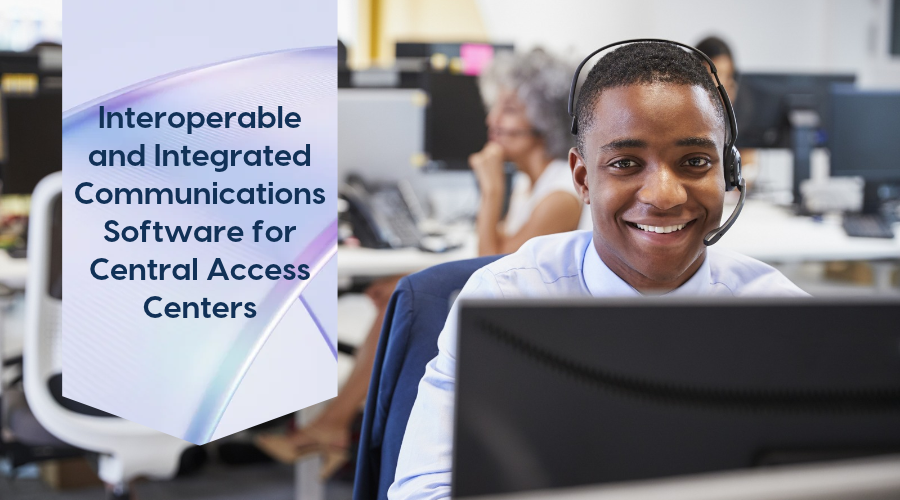
Across healthcare, government agencies, and large commercial organizations, the traditional call center has morphed into the Central Access Center. Rather than a traditional call center for individual customer inquiries, the central access center is the single point of entry and coordination hub for the entire organization. Whether managing patient transfers, bed placement, and physician consultations across a multi-hospital health system, or directing enterprise facilities maintenance, emergency dispatch, and regional service routing, central access centers operate in a high-stakes environment where seconds and accuracy matter.
Despite being the very heart of the organization, many central access centers are still held back by a lack of integration with their legacy software. The access coordinators and dispatchers are constantly switching among a disparate range of standalone telephony consoles, EHRs or enterprise CRM databases, alert monitors, and isolated on-call systems. That fragmentation of software creates a massive amount of operational friction, with staff having to switch between systems, manually key in the information, and update their paper schedules while high-priority calls and alerts queue up.
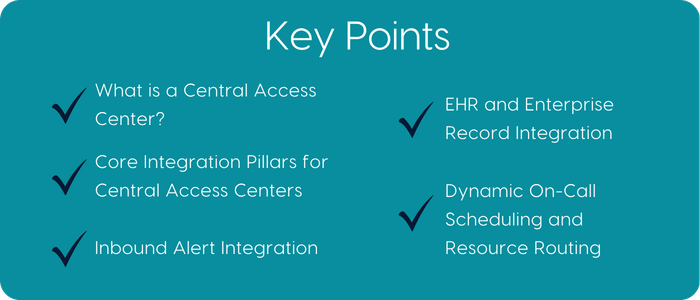
Highly interoperable and integrated communications software empowers central access centers across healthcare and broader enterprise sectors. The way to achieve this is via three core integration pillars: Inbound Alerts, EHR and Enterprise Record Integration, and On-Call Scheduling. The result is a highly robust call center software solution that can effectively remove the operational choke points. You get connected alarm response, less system switching, and a single SSOT (single source of truth) on-call system. Interoperable software transforms central access centers into unified command hubs.
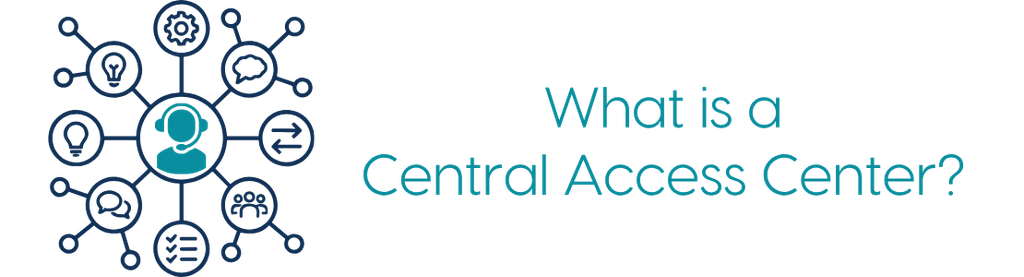
A central access center brings all the intake, triage, resource allocation, and dispatch functions together into one single operational layer. In the health care environment, this is the point at which patient admissions are managed, patient transfers are coordinated, direct doctor-to-doctor consultations are arranged, nurse triage is performed, and emergency codes are raised across the whole health network. Outside of healthcare, enterprise central access centers perform similar functions for multi-site campuses, utility networks, logistics hubs, and multiple commercial property locations—serving as the central command point for incident intake, vendor dispatch, security response, and escalation.
Related Case Study: Customized Communication Software for Patient Transfer Centers
Because central access centers sit at the intersection of external requests and internal resource availability, they can’t work with software that’s just a basic call router. Traditional automatic call distribution (ACD) platforms measure success through simple voice metrics like average speed of answer, but they miss operational context surrounding an interaction. When an associate receives a transfer request or an urgent facility alarm, answering the phone is only the first step. The true work lies in verifying records, checking real-time capacity or specialist availability, and executing multi-channel dispatches as quickly as possible.

When communications software lacks deep interoperability, the central access center becomes a manual switchboard rather than an intelligent coordination engine. Agents have to manually bridge disparate systems by copying data from an intake screen, searching separate databases for patient or account histories, and cross-referencing spreadsheets to locate on-call personnel. True interoperability resolves this bottleneck by establishing bidirectional, real-time data exchange across the entire enterprise ecosystem via open standards such as RESTful APIs and HL7/FHIR.
To function as an effective organizational nerve center, central access software must seamlessly unify three primary streams of operational data: live alerts, core records, and dynamic personnel schedules.
1. Inbound Alert Integration
Central access centers are typically the primary monitoring and response point for automated facility, clinical, and operational alarms. In hospital networks, these inbound alerts include nurse call notifications, facility alarms, panic buttons, and critical lab values. In commercial, municipal, and industrial access centers, inbound alerts originate from building management systems, security sensors, HVAC fault monitors, and automated IoT infrastructure.
Without direct integration, inbound alerts arrive on separate hardware terminals or isolated software dashboards, forcing coordinators to manually read raw alarm codes and initiate outbound calls. Interoperable central access software ingests these signals directly via standard protocols such as TAP and SMTP. Upon arrival, the platform sorts and translates technical codes into meaningful operational context, assigns priority levels, and places the event into the correct queue.
Related Case Study: American Communications Center
2. EHR and Enterprise Record Integration
Immediate access to data is essential for accurate triage and routing. In healthcare central access centers, the EHR contains vital patient demographics and care team assignments. In non-healthcare central access environments, the equivalent system of record is provided by an enterprise resource planning (ERP), customer relationship management (CRM), or computer-aided facility management (CAFM) platform, which contains housing tenant profiles, service level agreements (SLAs), asset histories, and site locations.
By connecting the communications platform directly to EHRs via HL7 and FHIR standards—or to enterprise databases via modern REST APIs—incoming interactions trigger automated screen pops. Using caller ID, interactive voice response (IVR) inputs, or incoming alert metadata, the software queries the system of record and displays the relevant patient or site profile before the operator even speaks. Equally important, bidirectional integration allows agents to log call dispositions, trigger transfer orders, or generate work tickets directly from their operator console, eliminating duplicate data entry.
3. Dynamic On-Call Scheduling and Resource Routing
A defining role of any central access center is connecting urgent requests with the exact specialist, physician, or field technician who is on call. Dispatch accuracy depends on real-time schedule visibility.
Historically, access centers have relied on static PDF rosters, shared spreadsheets, or disconnected web portals to track on-call coverage. However, changes happen and they are often last-minute updates. An interoperable central access platform integrates directly with enterprise scheduling systems, embedding live, continuously synchronized on-call schedules directly into the interface. When a transfer or escalation is required, the software automatically adheres to coverage rules and backup hierarchies in real time.
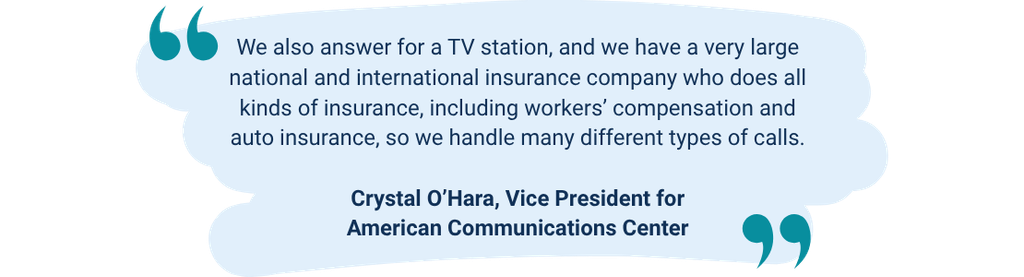
Integrating inbound alerts, records, and on-call schedules delivers real operational improvements across all types of central access centers. It’s all about replacing manual alarm relays, repetitive database lookups, and static shift rosters with automated, real-time synchronization. That, in turn, enables the agent to serve as the decisive operator rather than a manual data bridge. The benefits are tangible across every operational KPI: faster emergency response times, shorter handle times, reduced agent burnout, and demonstrable dispatch accountability.
As you evaluate your communications infrastructure, start by auditing where your teams lose the most time toggling between disconnected tools. Contact us to brainstorm, discuss your pain points, or request a demo.