Skip to main content
Skip to footer
Skip to main content
Skip to footer



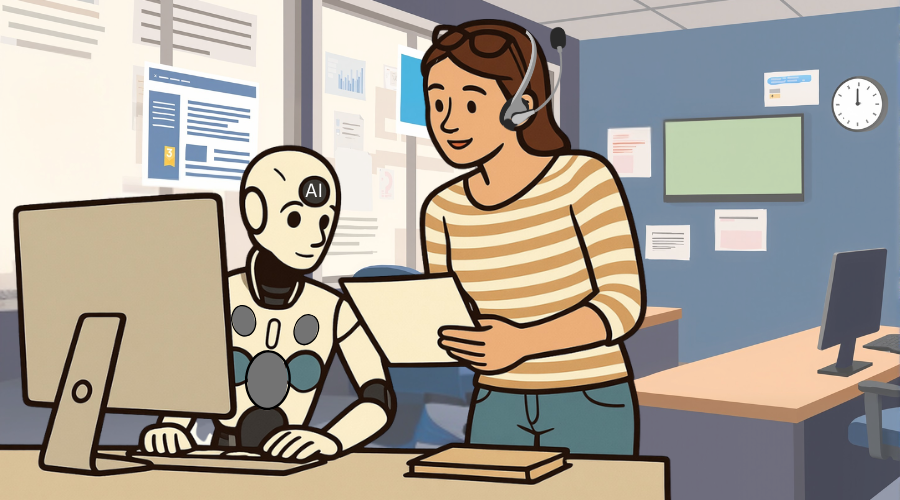
In AI-powered call center software, Human in the Loop (HITL) means that human agents and artificial intelligence (AI) work as a team, rather than the AI operating entirely on autopilot.
Instead of letting the AI handle 100% of a caller interaction or decision from start to finish, the software is deliberately designed to pause and loop in a human specialist at critical moments.
HITL has three main roles: escalation, agent assist, and training. If a caller becomes frustrated, uses complex language, or has a unique problem, the AI escalates the call and seamlessly hands the conversation and the full transcript over to a live agent.
When acting as an agent assistant, the AI operates in the background during a live call. It listens to the caller, pulls up relevant knowledge base articles, drafts responses, or suggests a solution. However, the AI cannot send the message or implement the fix until the human agent reviews, edits, and approves it.
People are responsible for quality assurance and reviewing the AI’s failures or low-confidence responses. By correcting the AI’s mistakes post-call, humans teach the machine learning model how to handle similar situations better next time.
In a hospital call center, the stakes for conversational AI are incredibly high. Because an AI cannot legally or safely decide if something said during a call constitutes a medical emergency, the transition to a human must be meticulously managed. An immediate handoff to a human operator is triggered based on precise, predefined clinical and operational thresholds.
Below are a few common scenarios of when that notification happens:
1. “Red Flag” Symptoms
The most critical triggers are clinical. During a call, the AI is programmed to listen for specific keywords or combinations of symptoms that indicate an urgent or life-threatening situation.
Example: A patient calls a clinic line complaining of a “bad stomach ache.” As the AI asks clarifying questions, the patient mentions that the pain radiates to their lower right side, it started suddenly, and they have a high fever.
Action: The AI recognizes the classic pattern for potential acute appendicitis. It immediately stops the automated intake flow, flags the case as high-urgency, and routes the call to a qualified agent or triage nurse, instantly displaying the collected symptom log on the screen.
2. The “Medical Advice” Boundary
AI software can guide a patient through a standard triage protocol questionnaire to assess urgency, but it cannot cross into clinical judgment.
Example: A parent calls because their toddler has a rash. The AI maps the symptoms to a low-urgency protocol, but the parent asks, “Can I give him this leftover antibiotic to see if it clears up?”
Action: Answering this requires licensed clinical judgment and a review of the patient’s chart. Because giving medication instructions violates strict guard rules, the AI will say, “I need a nurse to answer that safely for you. Let me get them on the line right now.”
3. Emotional Distress Signals
Advanced AI monitors more than just words; it tracks vocal sentiment, tone, and pacing.
Example: A patient calling to get lab results is incredibly anxious, speaking rapidly, crying, or becoming increasingly frustrated with the automated system.
Action: The AI detects the high-emotion threshold breach. Recognizing that this moment requires human empathy and a calming presence rather than structured data collection, it seamlessly alerts a supervisor or patient advocate to take over the call.
When these triggers occur, the AI packages the data it has already gathered—the verified patient identity, the confirmed symptoms, and the exact reason for the escalation—and presents it on the human operator’s computer screen. This ensures a person can step in instantly with: “Hi, Mr. Smith, I see you’re experiencing sudden lower-right abdominal pain. Let’s get you taken care of right away.”
Outside of healthcare, the primary goal of HITL switches from managing clinical safety to maximizing operational efficiency, customer retention/satisfaction, and high-value revenue.
In commercial call centers, like those in banking, insurance, retail, or support, an AI agent becomes a co-pilot for a human agent. Here is how it plays out across different industries:
1. High-Value Financial Decisions
While AI is great at checking an account balance or processing a simple windshield crack claim, it is restricted from finalizing complex or high-risk financial transactions without a human sign-off.
Example: A customer calls their bank to initiate an urgent, international wire transfer of $15,000 to buy a car.
HITL Action: The AI verifies the customer’s identity and gathers all the recipient’s banking details. However, before the money leaves the institution, the system pauses. It routes the structured data packet to a fraud prevention specialist’s dashboard. The specialist reviews the transaction for anomalies, clicks “Approve,” and the AI completes the transfer.
2. Retention and “Churn” Detection
When a caller wants to cancel a service, letting a machine handle it often results in lost revenue. Humans are vastly better at reading subtle emotional cues and negotiating.
Example: Someone calls a cable company and tells the AI, “My bill is too high, just cancel my service.”
HITL Action: The AI recognizes the intent as “customer churn risk.” Instead of processing the cancellation, the AI instantly flags a retention specialist. While transferring the call, the AI uses a background script to analyze the caller’s account history and populates the agent’s screen with three tailored promotional offers that are highly likely to convince this specific customer to stay.
3. Tiered Tech Support
AI can be efficient at walking users through basic troubleshooting. It loops in a person the moment the problem requires manual configuration or deep technical deduction.
Example: Someone calls a software help desk because their corporate VPN won’t connect. The AI guides them through clearing their cache and checking their WiFi, but the error persists.
HITL Action: The AI exhausts its Tier 1 troubleshooting script. It tells the caller, “I’m going to bring in one of our network engineers to look at your router configurations.” The Tier 2 engineer receives the call along with a log of everything the AI has already tried, so the caller doesn’t have to repeat everything they’ve said to the AI.
With HITL, the AI does the heavy lifting of data retrieval, pattern matching, and drafting, while the human provides empathy, critical thinking, and final authorization. This approach gives call centers the efficiency and speed of automation without the risk of a rogue AI hallucinating a policy or alienating a caller.