Skip to main content
Skip to footer
Skip to main content
Skip to footer


For years, backend systems architecture was treated like the plumbing—essential, but hidden away until something leaked. Now, amid the rapid push for data exchange during COVID-19 and the explosive growth of Artificial Intelligence (AI) integrations, architecture has become the star of the show.
The pandemic forced hospitals to focus on interoperability in order to instantly share patient data across disparate networks, public health systems, and telehealth platforms. It proved that data silos are a literal risk to patient outcomes. Interoperability shifted from a compliance checklist item to a survival requirement.
Today, the push for hospitals to use AI tools requires clean, real-time data pipelines. If a hospital doesn’t map out its IT landscape through a comprehensive architecture audit, it risks feeding AI inaccurate or delayed data. Your system needs to perform IT architecture audits because you can’t secure or optimize what you don’t know exists. If your hospital’s IT landscape is messy, fragmented, or undocumented, dropping an AI layer on top won’t fix it; it will just automate the chaos at scale.
Architecture isn’t a static blueprint anymore. It’s a dynamic, interconnected web where changing one interface, like an Electronic Medical Record (EMR) update, ripples through every connected utility. For hospitals to leverage intelligent automation and maintain patient safety, they must treat systems architecture as a dynamic, strategic asset. This paper examines how architectural audits support hospital call centers.
Hospital call center software is no longer just a digital switchboard. It’s the critical communication hub of the entire enterprise. When an emergency happens, the call center environment routes data to the right person at the exact right second. Here is how architecture directly impacts your call center:
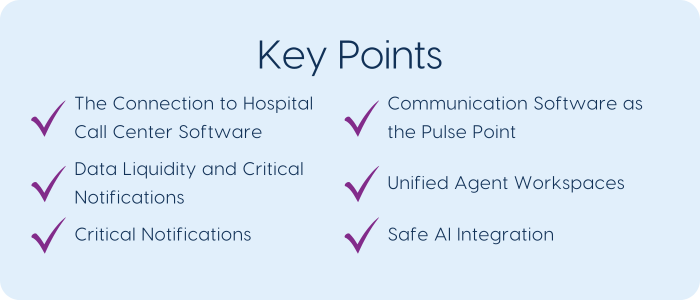
Data Liquidity and Critical Notifications: If a patient’s telemetry monitor flags a critical event, or an ER reaches capacity, that data must flow instantly through the middleware/integration engine to the communication software. Poor architecture creates latency—and in healthcare, a delay in a notification can change a clinical outcome.
A large-scale study conducted by the Kaiser Permanente Division of Research, evaluating data from 21 hospitals, found that real-time predictive models work only when data can flow seamlessly across platforms. A sophisticated system that actively scanned EMRs and routed automated risk alerts to a clinical team reduced mortality among high-risk patients by 16%. The system integration shortened the average hospital length of stay (LOS) from 7.5 days to 6.7 days.
In this case study with Northbay Health, you’ll see how Amtelco’s Architecture Solutions team reviewed the analog alarm board to enable it to communicate with updated digital call center software. When considering data flow, there are times when systems that need to exchange information are analog and weren’t designed for a digital environment.
Contextual Triage for Operators: When an agent takes a call, a well-architected system instantly pulls data from the EMR, the scheduling system, and the on-call schedule. If the integration architecture is fragile, the agent isn’t presented with the most accurate, up-to-date information available, forcing them to manually look it up while a panicked caller waits.
AI Readiness at the Front Lines: If your system is interested in using AI voice bots or ambient listening tools, your call center, AKA the hospital’s communication hub, must have a rock-solid, audited architecture. In addition, any communication software needs clean APIs to feed data to the AI model and safely push the resulting actions back into clinical workflows.
To transition safely and effectively into an AI-driven environment, healthcare organizations are turning to comprehensive architecture audits to map data flows, identify security vulnerabilities, uncover hidden technical debt, and ensure system redundancy. A hospital doesn’t just run one software system—it runs hundreds. An audit turns blind spots into a visible map of how platforms interact.
Nowhere is the health of a hospital’s architecture more evident than in its call center and communication software. The communication hub is not a standalone silo; it is the primary intersection where clinical data meets human action to take care of patients. That makes it the clearest point to see how architecture supports care.
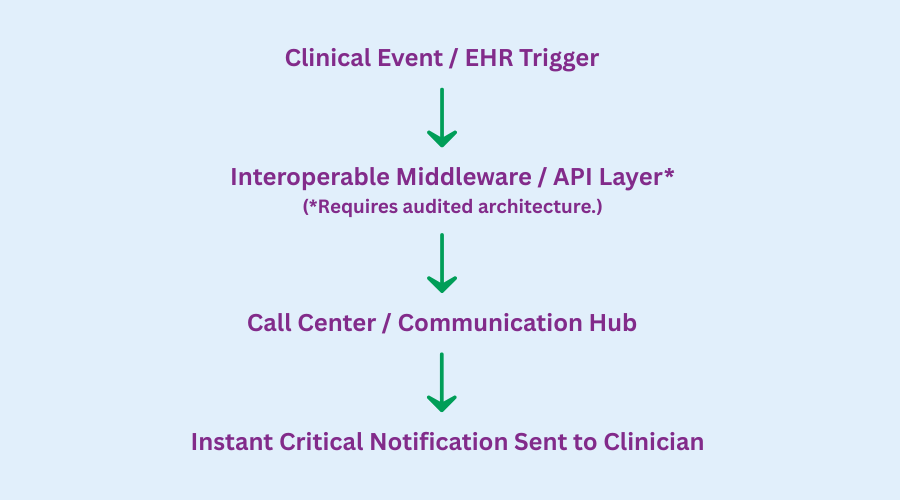
When systems architecture is optimized, the benefits to the communication ecosystem and patient care are profound:
Critical Notifications: Code alerts, stroke team activations, and panic lab values travel from the point of origin to a clinician’s mobile device in milliseconds, completely bypassing manual lookup errors. In Automated alert and activation of medical emergency team using early warning score, published in the peer-reviewed journal Acute and Critical Care, shows that when a hospital’s backend architecture automatically pushes clinical alerts directly through the communication infrastructure, rather than relying on manual telephone routing, it shortened the median time from patient deterioration to Medical Emergency Team (MET) activation from 60 minutes down to 34 minutes (a 43% reduction). This architectural automation led to a significant drop in unplanned ICU admissions (from 71.8% down to 41.2%) and a decrease in overall hospital mortality (from 38.5% down to 27.2%).
Unified Agent Workspaces: Interoperable call center architecture aggregates and unifies data from on-call scheduling databases, admitting systems, and directory registries to reduce average handle times.
Safe AI Integration: By auditing and documenting the IT environment, hospitals establish the secure, high-speed API pathways required to feed conversational AI and automated routing engines without risking patient data exposure.
Interoperability and structural design are no longer passive IT concerns. They are foundational to clinical excellence and operational readiness. As hospitals prepare for a highly automated, AI-assisted future, auditing the enterprise landscape is the essential first step. By prioritizing architectural integrity within the communication hub, healthcare leaders ensure that their most vital data reaches the people who need it most—instantly, securely, and without failure.