Skip to main content
Skip to footer
Skip to main content
Skip to footer


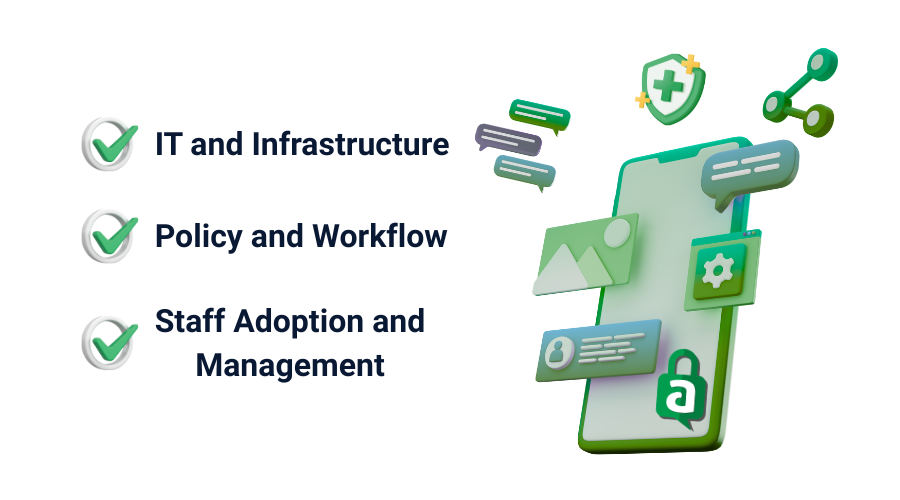
When implementing a secure messaging app, hospitals should be particularly mindful of several common pitfalls to ensure successful adoption and to maintain compliance and patient safety.
1. Technical and Infrastructure Mistakes
Sparsely populated areas often lack sufficient broadband access, and hospital buildings can have areas with poor or no internet connectivity, known as “dead zones.” Message delays or failures will quickly erode staff trust in the new system. Conduct a thorough wireless infrastructure audit to identify and correct dead zones and ensure reliable coverage across the entire facility.
2. Policy and Workflow Mistakes
Hospitals can be vulnerable to cyberattacks due to limited resources. Ensure the secure messaging app is a proper HIPAA-compliant solution with strong security features, and implement strict policies mandating the use of the secure app for all clinical communication involving PHI.
Establish clear mobile device management (MDM) and bring your own device (BYOD) policies to address password requirements, auto-lock features, and remote data-wipe capabilities for the secure app on personal devices.
Uncontrolled messaging can increase clinician burnout and lead to errors. Implement features and policies that differentiate between urgent (high-priority alerts) and non-urgent (chat-based) messages. Also, ensure the system supports an easy way for clinicians to truly disconnect when they are off-call.
3. Staff Adoption and Management Mistakes
Staff won’t use a tool they don’t understand or see value in. Provide mandatory, comprehensive training for all staff. Clearly articulate the benefits and how the app improves their specific workflows.
Avoid limiting the app’s use to just physicians. If nurses, social workers, and other essential care team members don’t have access, the platform’s utility is severely limited, and staff will revert to unsecure communication methods. Ensure the secure messaging system is rolled out to all care team members who need to communicate about patient care to foster a culture of secure and efficient collaboration.
[Related White Paper: Why Secure Messaging Apps are Critical for Rural Health Systems with Tips for Transitioning from Pagers to Apps]
Don’t underestimate the need for ongoing support and optimization. Technology is not a “set it and forget it” solution. Appoint a dedicated project team, continuously measure success (e.g., faster response times), and plan for ongoing training and optimization as new features are released.