Skip to main content
Skip to footer
Skip to main content
Skip to footer



Telephone Answering Services (TAS) operate in a unique environment that’s different than traditional contact centers. While standard call centers often handle inbound and/or outbound calls for a single company or organization, TAS providers manage hundreds of distinct accounts, frequently handling critical after-hours routing, emergency dispatch, and complex client-specific protocols.
TAS industry articles usually highlight the same high-level narrative about high agent turnover, strict SLA (Service Level Agreement) demands, and stress over HIPAA or security compliance. While these problems are absolutely real, there are smaller issues that happen every day that deserve attention because they can drain a TAS’s profitability, frustrate operators, and drive clients to look elsewhere.
Behind the scenes of an answering service, profitability can be eroded, second by second, by account-switching fatigue, system latency, and scheduling gaps. Here is a look at the hidden pain points TAS businesses face every day, along with how purpose-built software can turn these issues into competitive advantages.
1. Micro-Context Switching and Cognitive Fatigue
Micro-context switching, hyper-shifting, and split-second pivoting are convoluted ways to say your TAS operators are busy helping a diverse client base. Unlike traditional single-brand call centers, where an agent handles similar inquiries all day, a TAS agent might handle a pediatric emergency, instantly switch to a funeral home dispatch, and then take a call for a tow truck service—all in under three minutes. The sheer mental toll agents experience when they need to reset their tone, logic, and procedures every few seconds causes severe cognitive load, leading to rapid agent exhaustion and possibly costly handling errors.
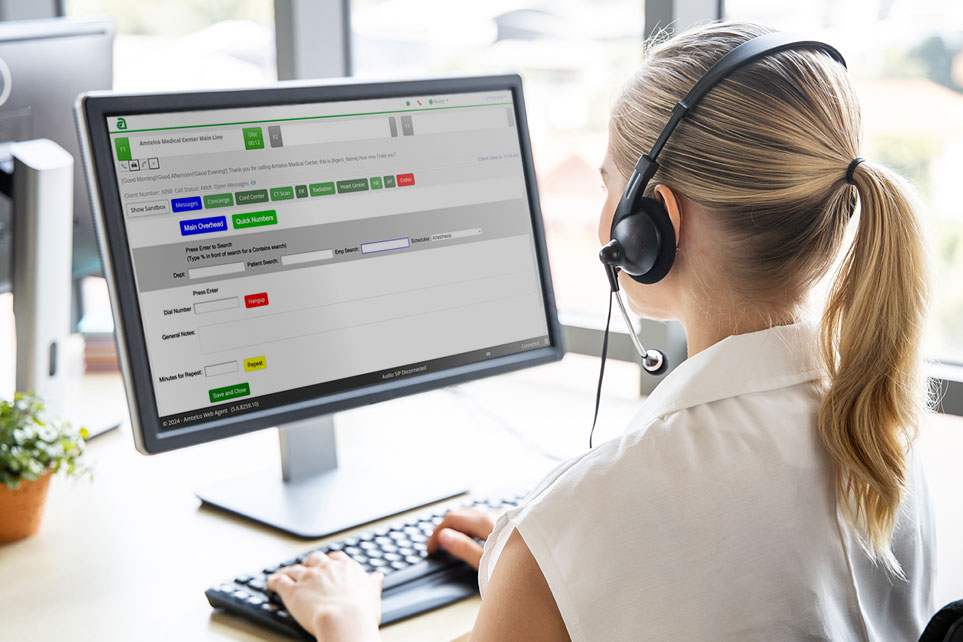
Specialized TAS software can provide relief by knowing what the agent will need before the call is answered. The system recognizes incoming calls and presents only what is needed for that call to the operator. The operator doesn’t need to worry about the specific greeting, script, required fields, or time-of-day logic needed for that particular call.
“Currently, we ask a question on the screen and fill out a hypertext link that directs agents to the next step. Our office account is split into subaccounts based on who they’re asking for because each has different instructions. Now, with scripting, we can build a script for each person, which simplifies programming, and cuts out a lot of information that we don’t need.” Crystal O’Hara, Vice President for American Communications Center in Reading, Pennsylvania
Using advanced scripting also means your agents don’t need to search through account manuals or wait for a screen to load. In TAS billing models, time is money. When a call comes in, every second an agent spends researching client protocols, waiting for databases to sync, or for dispatch screens to pop, creates awkward silences for the caller. These short delays inflate average handle time (AHT). When you add that up across thousands of daily calls, you might find you’re burning paid, billable minutes due to system lag.
2. Managing On-Call Directory Chaos
Sometimes, TAS businesses are blamed for the client’s administrative oversights, risking account churn. If employee A trades shifts with employee B and no one notifies the TAS, it can result in dispatching the wrong person, delayed responses, and furious clients.
Modern TAS platforms provide on-call scheduling software that offers web portals and mobile apps to empower both operators and clients. Users can manage schedules in real time, and easy remote access and automated scheduling help to simplify complex schedules. If a dispute arises, the software provides undeniable audit trails.
“One thing we love about the on-call directory is that we can click on a button that highlights only the available staff who are actually on-call at that very moment. It prevents a lot of confusion, especially when an override has been done for last-minute schedule changes.” Ashley Banuelos, PBX Supervisor for Ephraim McDowell Health in Danville, Kentucky
3. Manual Patching and Escalation Overhead
Connecting a caller directly to an on-call technician or physician often involves manual warm transfers, tracking down secondary contacts if the primary doesn’t pick up, and manually logging every attempt. This additional work occupies the agent, causing other incoming callers to wait in a queue.
Instead, automated dispatch trees can initiate secure app pushes, SMS alerts, or outbound voice calls to the on-call contact. Self-escalating protocols are set to trigger if the primary contact doesn’t acknowledge the alert within a specified window (e.g., 2 minutes). If this happens, the platform automatically escalates to the backup contact and logs every step—zero agent manual intervention required.
[Related: Directories-The Power Behind Smarter Call Centers]
4. Client Billing and Small Discrepancy Disputes
TAS providers bill clients for talk time, wrap-up time, or message units. Clients sometimes dispute invoices for automated spam calls, wrong numbers, or long ring times that are billed to their accounts, forcing administrative staff to waste hours reviewing call logs to justify small charges. Billing disputes not only eat up administrative time but also strain client relationships.
However, advanced software offers granular billing categories and automation to identify and tag spam, auto-dialers, or immediate hang-ups, which enables an auto-credit process or the ability to exclude junk calls before invoices are generated.
Giving clients line-item visibility, along with attached audio recordings or message receipts, also eliminates invoice friction before it turns into a dispute.
“We’ve found Amtelco’s software is very easy to use, helping us quickly search and find the metrics for a specific call. Verifying quality control is very important to us and our clients. Whenever we have a client question about a call, we verify the operator asked all the required questions and can hear the interaction between the caller and the operator. Call scoring sets Amtelco’s software apart from a previous program we used. We appreciate the flexibility and customization that we can achieve based on the metrics we choose.” Darren Stevens, System Administrator for Southern Voices in Winston-Salem, North Carolina
5. QA Coverage Gaps on Non-Standard Accounts
Traditional call centers evaluate quality by listening to 1–2% of calls against a single standard script. This isn’t possible for a TAS managing 500 different accounts with a multitude of call scripts. Standard quality assurance (QA) sampling for a TAS can easily miss account-specific protocol violations. A TAS call might sound polite, but if the agent misses a custom requirement, the client will be unhappy.
Leading-edge software with automated AI-powered speech analytics can score 100% of calls against account-specific rule sets. The software actively listens during a call and alerts the agent (or supervisor) in real time if a required protocol step was missed before the caller hangs up.
To address these pain points and win in the modern TAS landscape, software can’t only act as a digital notepad and phone switch. It must move beyond the basics and serve as an intelligent operational cushion that absorbs work and other complexities on behalf of your agents, protects profit margins from hidden latency, and provides accountability for client operations. Addressing these overlooked operational realities is what separates thriving TAS businesses from those struggling under the weight of manual overhead.